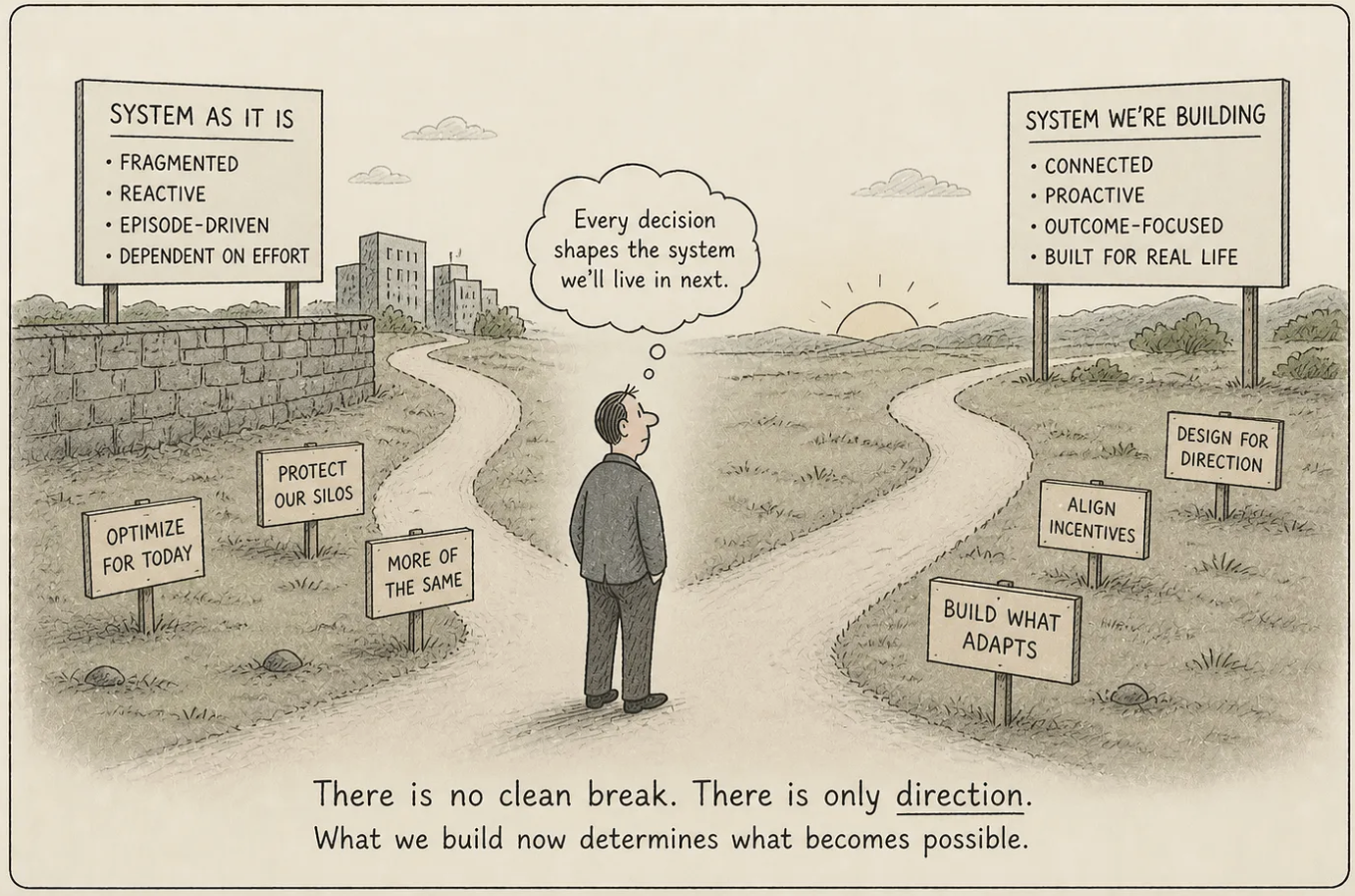
We do not get to start over. We build on a system that is already under strain, using structures designed under different assumptions.

The demographic pressure is real. The structural failures are well understood. The constraints, financial, political, and operational, are not going away. The solutions being built today will either move the system toward greater coherence or quietly reinforce the architecture already in place.
The question is what we are actually building toward.
The most durable shift begins with something that sounds simple and is not. The system has to organize around the person across the full arc of their life, rather than around the categories we use to administer services.

Every part of the current system is built around a category, age, diagnosis, eligibility, or funding stream. Those categories are useful for administration but are far less useful for understanding a person whose needs change over time, often in ways that cut across those boundaries.
The shift that matters is from categorical thinking to longitudinal thinking. What does this person need now, given their circumstances? What are they likely to need as those circumstances change? Who is in a position to support them at each stage, and what do those people need to know?
When you organize around those questions, the architecture begins to change. The focus moves from episodes to relationships. Success is measured over time, not at a point. Technology plays a different role: less about capturing information and more about ensuring the right information reaches the right person at the right time.

The infrastructure we have built is real, and it should not be dismissed. But it is incomplete. What is missing is the ability to distinguish signal from noise and to direct that signal toward action.
Most of what a care system generates does not require a response. Most data points are background, useful in aggregate and over time for analysis. They are not useful to the person who has to decide what to do next.
What is needed is a function that holds observations over time, recognizes when something is beginning to change, and surfaces that change clearly to the person who can act. Not a dashboard. Not a collection of alerts that require interpretation. A clear indication that something is shifting, why it matters, and who needs to be aware.
In practice, this often looks very simple. A direct support professional notices that someone has been less engaged over several days. A family member mentions that appetite has changed. A prescription is not picked up. None of these triggers a response on its own. Together, they point to a trajectory moving in the wrong direction, and to a window, still open, where a conversation or a visit changes what happens next.
Today, there is no reliable mechanism for connecting those observations. They sit in separate places, held by different people, across different systems. The infrastructure to move the data may exist. The layer that makes sense of it and ensures it leads to action does not.
Building that layer is not about adding another system. It is about introducing judgment into how information is used. It requires restraint, deciding what not to surface, and being disciplined about it. When that function is in place, coordination stops being something we ask people to do. It becomes the natural result of how the system operates.
None of this holds without alignment in incentives. A system built around relationships and early intervention cannot be sustained if it is funded entirely through episodic reimbursement. Preventing a hospitalization has to matter as much, or more, than treating one.
Payment reform is slow and uneven. It will not arrive all at once. But waiting for it is not a viable strategy.
The path forward is to build in ways that demonstrate value within today’s constraints, while making that value increasingly visible as payment models evolve. That means measuring what matters over time, not just within a program, and using that evidence to support a different way of funding care.
This is where the tension becomes real.
Everything being built today has to work within a system that still rewards many of the behaviors that need to change. There is no clean break. No moment where the old system is replaced by a new one.
There is only one direction.
Each decision, what to build, how to structure it, what to measure, either moves toward a more coherent system or reinforces the one that is already failing. Not every decision can optimize for the future. The present imposes real constraints, but the direction should be visible and deliberate.
That means building solutions that fit into existing workflows rather than disrupting them unnecessarily. It means reducing cognitive burden, not adding to it. It means translating complexity into something that feels simple to the people who actually have to use it.

Simplicity is not a feature. It is what makes adoption possible.
The system will not be rebuilt from scratch. It will evolve, unevenly, under pressure, from what it is today toward something that can handle what is coming. The people shaping that evolution will do so through a series of choices, many of them small, about what matters and what does not.
The frame that matters is not a category. It is the person moving through a system that was not designed for them, at a moment when that system can no longer absorb its own inefficiencies.
The signals are already there.
What we build determines whether they lead to action.
Need a hand? Not sure where to start?
We're here and happy to help. Drop us a line and we'll get back to you or call Support at (877) 694-4431.
We also have tons of articles and videos on our help page for many frequently asked questions.
Privacy is important to us, so you have the option of disabling certain types of storage that may not be necessary for the basic functioning of the website. Blocking categories may impact your experience on the website. More information


