
Somewhere along the way, healthcare quietly changed the job description. Not for physicians, nurses, or health systems themselves, but for families.
Over the years, I have spent time with individuals and families across hospitals, skilled nursing facilities, physician offices, and homes. While every story is different, a familiar pattern tends to emerge. At some point, usually quietly and without discussion, responsibility shifts. A spouse begins managing medications because discharge instructions feel unclear. An adult child starts coordinating appointments because no one else sees the full picture. A family member notices subtle changes in mood, appetite, mobility, or behavior and starts paying closer attention because something simply feels different, even if they cannot fully explain why.
Rarely does anyone formally ask them to assume this role, and even more rarely does anyone prepare them for it. Yet increasingly, the healthcare system depends on them.
We often talk about family caregivers as though they provide support around the edges of healthcare. Increasingly, that is not what is happening. Families have become part of the operating model itself. As care has moved beyond hospital walls and become distributed across specialists, skilled nursing facilities, home health agencies, community organizations, and the home itself, the work of connecting those pieces never disappeared. Someone still needs to understand changing care plans, communicate across organizations, notice meaningful changes, and help ensure that recommendations actually become actions. In many cases, the only person consistently present across all of those moments is a family member.

Yet, despite this reality, healthcare often continues to treat families as optional participants rather than as critical infrastructure. This creates an uncomfortable contradiction: we continue to ask families to assume greater responsibility while often giving them less of what they need to succeed. They frequently operate with fragmented information, limited visibility, inconsistent communication, and uncertainty about where responsibility actually begins and ends.
The challenge is not simply that healthcare has become complicated. Complexity exists in many industries. The deeper issue is that families increasingly function as coordinators without authority and decision makers without complete information. They are expected to advocate effectively, recognize problems early, and make important judgments, even though they often lack the broader context needed to understand what they are seeing.
Much of this work remains invisible. There is no operational metric for the daughter spending two hours trying to reconcile conflicting medication instructions after discharge. There is no dashboard tracking the husband, who notices subtle behavioral changes before clinical symptoms become obvious. There is no productivity measure for the son stepping away from work repeatedly because appointments, transportation, and phone calls have quietly become his responsibility. Yet these activities increasingly support the broader healthcare system.
Interestingly, policymakers increasingly appear to recognize this reality. State, local, and federal initiatives have expanded support for caregivers through family navigation programs, respite services, caregiver training, Medicaid waivers, and broader efforts in care coordination and whole-person care. These efforts reflect an important shift in thinking because they acknowledge something many families have understood for years. Health outcomes are often determined by events that occur between clinical encounters rather than solely during them.
Yet there remains a meaningful gap between recognition and reality. Ironically, many of these efforts acknowledge the importance of family participation while still relying on unpaid or under-supported labor as part of the underlying operating assumption. Families continue to serve as coordinators, observers, advocates, and informal care managers without the infrastructure or payment models designed for the role they increasingly play.
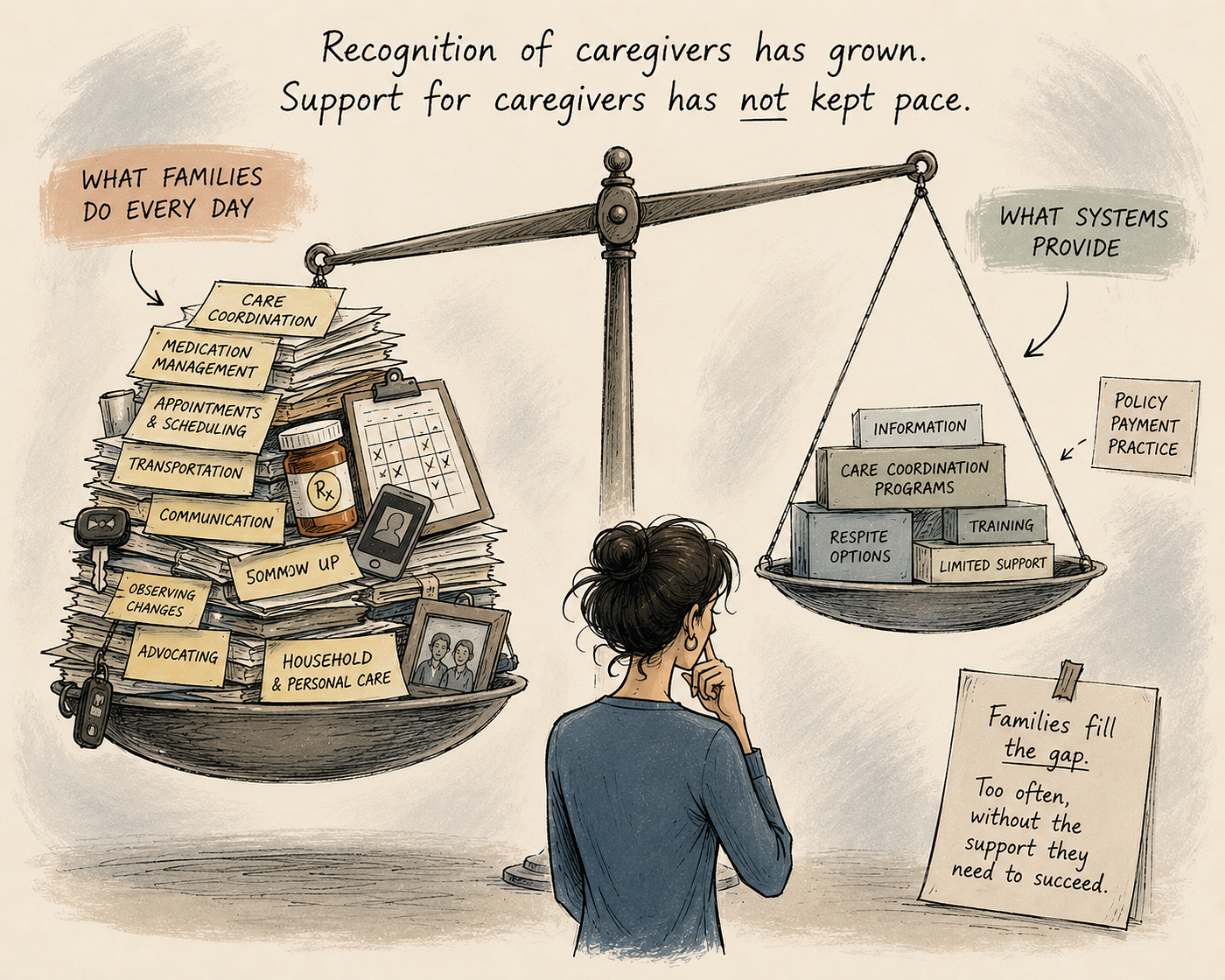
Healthcare historically developed around reimbursing clinical activity through visits, procedures, and interventions. We have been far less effective at supporting the work that occurs between those moments, even though that work ultimately determines whether care plans succeed or fail. The challenge is not necessarily that family members should receive compensation for every task they perform. Rather, we increasingly depend on them to support functions that directly influence outcomes while investing relatively little in the systems, services, and supports that would enable them to succeed.
The emotional cost often remains invisible as well. For many families, the burden extends well beyond performing tasks. A persistent level of responsibility begins quietly moving into everyday life. People listen for phone calls, replay conversations with physicians, wonder whether they missed something important, and carry a lingering concern that a misunderstanding, forgotten detail, or delayed response may affect someone they love.
These consequences do not remain isolated within families. Fragmented communication contributes to delayed interventions, avoidable emergency visits, medication issues, and preventable readmissions. Organizations frequently make decisions with incomplete pictures, and greater effort does not necessarily translate into better outcomes.

Families were never intended to become the connective tissue of modern healthcare. Yet for millions of people, that is increasingly what has happened. Across settings, organizations, and transitions, families frequently serve as the consistent presence that holds together information, decisions, observations, and support. We can continue treating this as an informal arrangement that families somehow absorb, or we can recognize something that is becoming increasingly difficult to ignore: one of healthcare’s most important care-delivery assets may also be one of its least supported.
Need a hand? Not sure where to start?
We're here and happy to help. Drop us a line and we'll get back to you or call Support at (877) 694-4431.
We also have tons of articles and videos on our help page for many frequently asked questions.
Privacy is important to us, so you have the option of disabling certain types of storage that may not be necessary for the basic functioning of the website. Blocking categories may impact your experience on the website. More information


